
This is part of a series on election security, about the lessons learned from a recount we participated in (see this podcast episode). It led to a few simple, concrete suggestions for reforms that would improve election security:
Have voters sign the paper voter roster with a date and time, and have the election clerk sign the bottom of the roster (see our last post).
Provide access in recounts to the critical piece of documentation to verify chain of custody and the total number of ballots cast — the Ballot and Seal Certificates — in all recounts (see our first post).
Provide access to the voter rosters in all recounts (these were in the ballot boxes, but we were denied access to them in our recount).
There are many other important improvements that need to be made — ending countywide voting (which makes recounts impossible), as well as ditching the voting machines. The three suggestions above however are simple. They require no change in law or policy. They also help secure our elections without any additional time or expense.
Making available the critical documentation for recounts? Easy. Having voters sign the paper voter roster? Simple.
These cost-free measures would provide good checks for fraud. Observers in a recount could reconcile the numbers, and look to the voter roster to see if signatures were done in all the same handwriting. If they were, those voters could be found and asked whether they voted.
If implemented, they would be a good deterrent, and would raise trust in our elections, which have come under such fire this decade.
By contrast, the “recount” process we went through was expensive, time-consuming, and frankly idiotic as it provided no safeguards against fraud.
Why don’t we do these things already?
Actually, we did do them in the past. Dallas County did have voters sign a paper voter roster just two midterm elections ago. It was only in 2019 that Dallas County went to countywide voting on election day and changed to electronic pollbooks. The initial rollout was disastrous, as we spent $6 million on ePollbooks that were not secure, and had to be replaced.
Going back to voters signing a piece of paper would be a great upgrade. Signatures on a touchscreen are ridiculous scribbles that are impossible to verify. Why are they allowed? The change came in 2013 by HB 2373, carried by Rep. Stephanie Klick. Just weeks after that bill became law, the Secretary of State approved the equipment and software of a number of companies who were clearly waiting in the wings to get contracts.
Even more than electronic signatures, countywide voting makes voting much less secure. The argument for countywide voting is convenience for voters. But did it make any difference? The Secretary of State provides various reports to the state legislature on elections, which show that countywide voting in Dallas did not increase turnout. In fact, the change in turnout in Dallas County lagged behind the change in turnout statewide in 2019, compared to 2015 and 2017. In 2019 statewide turnout was up 6.6% from 2017, but only 3.2% in Dallas County. In 2015 statewide was up 1.0%, but Dallas County increased only 0.7%.
So the convenience argument does not pan out. And countywide voting is a disaster for election security, as it makes recounts impossible, as we found out first hand.
Here’s why. If a voter can vote anywhere in the county, a recount would require opening the ballot box of every early and election day voting location and go through every ballot to find ballots for that particular race. That is impossible, so instead we relied on the computer printout for how many ballots for the city council race was in each ballot box. Of course, this assumes that the tabulator and aggregator are infallible, the source of all truth. But if we know one thing, it’s that they are not: the phenomena in 2020 of “phantom voters” at Irving Arts Center, or the polling location in Oak Cliff where none of the votes were counted, showed the opposite.
Countywide voting means no election can ever be recounted. You just retabulate the votes until you get to the total the computer printout says, and then you stop.
Combine the lack of real signature verification with countywide voting, and you get a situation asking for cheating. As anyone who has studied US elections knows, there is a long and storied history of election fraud in the United States. The classic technique is to get “repeaters” to vote multiple times. (Edgar Allen Poe actually died after serving as a Whig repeater.) With countywide voting, you can get fraudulent IDs — or just use an easy-to-forge utility bill and declare you have an impediment — and go to different locations.
In the District 3 general election that there was a recount for, we cannot be sure that there were not repeaters. The good news is that it is unlikely that ballots were added after hours, at least to the location with the late night vote dump we were focusing on, as we tracked down the results tapes from the tabulator at that location. The tabulator is the machine at the location that voters put their ballot into, and which actually counts the votes. At the end of the night on election day the election judge prints the tapes from the tabulator. The version turned in to central count is seen below; and the version kept by the judge was the same, lacking only the signature of the clerk at the bottom.
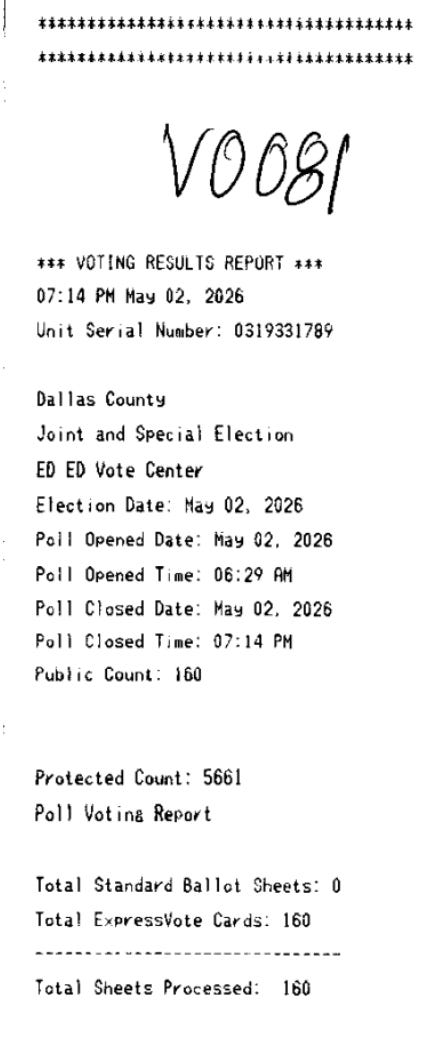
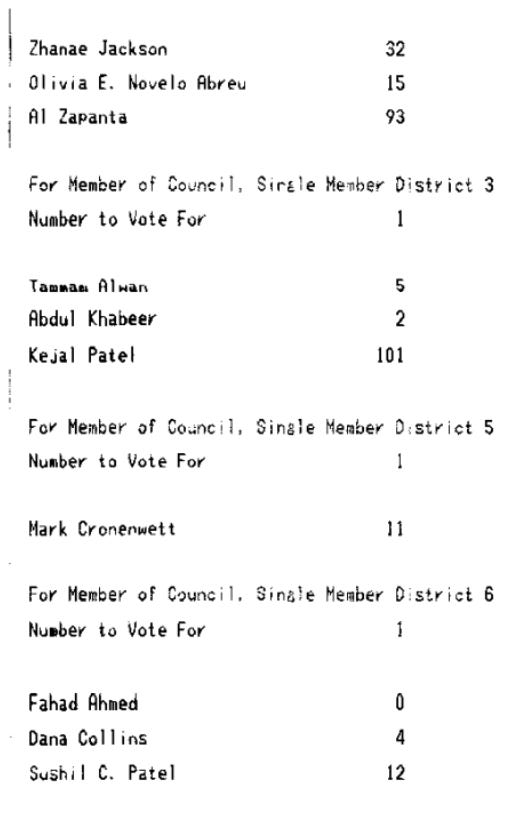
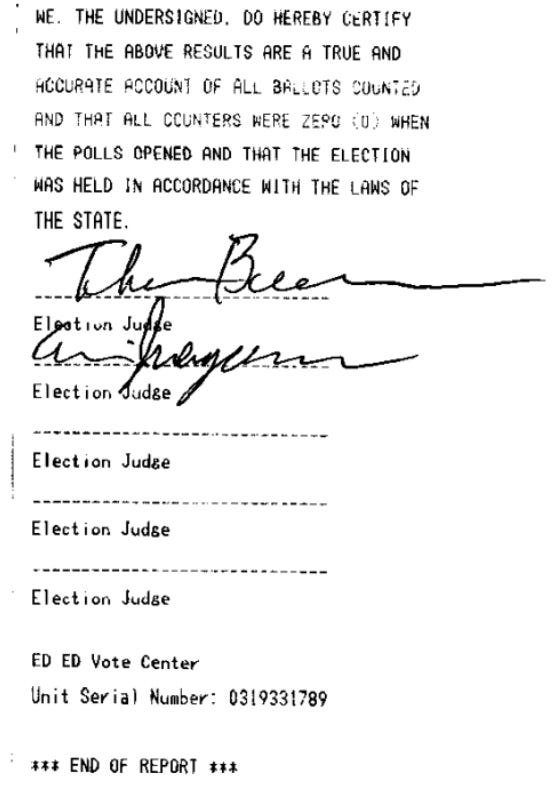
This tape was not produced at the recount, but only in response to an information request, so we did not see the original but only an electronic version. It matched the physical version held by the election judge, which we did examine, with the only difference being the second signature was lacking in his copy.
These two copies verify the date and time that the 160 votes were tabulated at this location. This is a solid verification mechanism, though not completely foolproof, as someone with admin access could have added ballots in the ballot box and taken out an equivalent number for the opposing candidate; this would align with the voting tape and be untraceable in a recount, especially as we had no record of the ballot box seal.
But the printed tapes are a good validation measure. As with the Ballot and Seal Certificates and Voter Rosters, they should be available in every recount. Why wouldn’t they be? Recounts cost candidates thousands of dollars, who would seem to deserve automatic access to the critical election records. This transparency would be a deterrent against fraud. Without seeing the tapes, the voter rosters, and the Ballot and Seal Certificates, how can the total number of ballots cast at a location be verified? If recounts do not have easy access to these, then transparency the public must rely upon Public Information Requests, which can be costly and also can be denied without explanation. All that does is provide peace of mind to potential fraudsters.
Happily, a significant election transparency improvement was implemented during the recent runoff election: the successful printing of the results tapes from each DS200 precinct tabulator at central count before the unofficial Early Voting results were uploaded or transmitted. This allowed election officials, poll watchers, and authorized observers to verify the vote totals recorded by each precinct scanner prior to electronic reporting.
This improvement was at the request of Tami Brown-Rodriguez, the interim chair of the Dallas County Republican Party at the time, who has worked to promote election integrity for the past decade.
Mrs. Brown-Rodriguez recently lost a tightly contested election for GOP county chair to Mr. Monty Montanez. After being elected, Mr. Montanez met with Elections Administrator Paul Adams at central count, and said afterwards that he has “complete confidence in” Adams while adding, “Being there and walking through and asking all the questions and listening to everyone, I felt completely comfortable that our elections are secure.” This view is in step neither with the current Republican president nor with our experience doing a recount. We reached out for comment to Mr. Montanez, and got this response back:
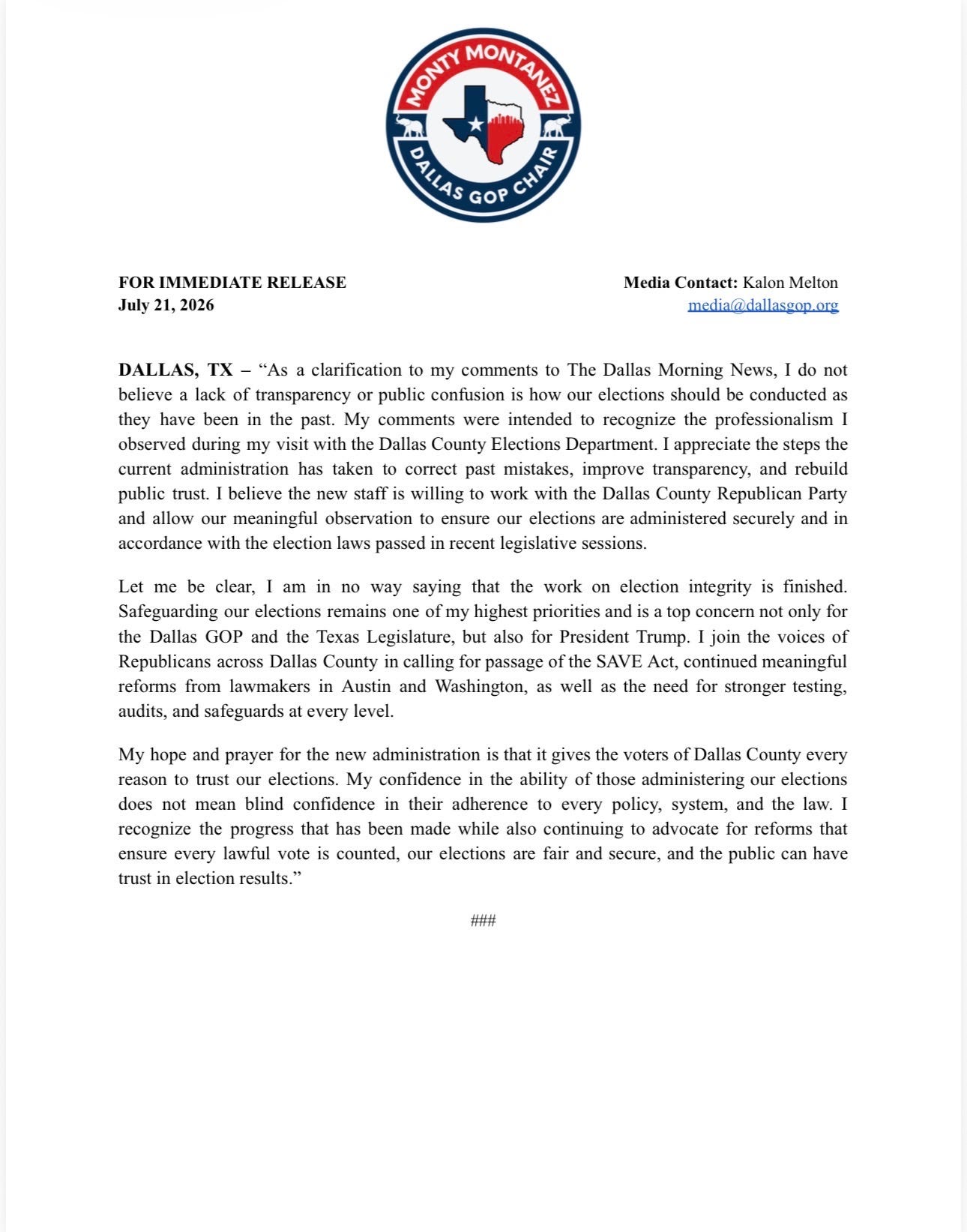
Hopefully we will have him on our show in the coming months.
By contrast, multiple messages and emails to the head of communications at the Dallas County Elections Department over the past couple months have been ignored.
Contact: TheIrvingHerald@gmail.com (corrections/comments/news tips welcome)
© 2026 Irving Herald LLC. All rights reserved.