
This is the second this series of posts offering reflections on our elections as a result of participating in the recount last month of the City Council District 3 May 2 Municipal Election.
In the first post, we discussed how the crucial documentation for each ballot box — the Ballot and Seal Certificates — were not made available for the recount ballot boxes. That was striking, since these forms are essential for cross-checking the amount of votes in each ballot box and the seals securing them. The one we did ask for and receive, for a critical location, turned out to be grossly incomplete, with many fields missing, including total votes and the seals on the ballot box. Without this documentation, there would be no way to trace if the ballot box had been tampered with, with ballots added or subtracted.
Is this a far fetched notion though? Perhaps thinking this way is the result of an overheated imagination in the wake of learning certain things, like the fact that the McDonald’s Monopoly game of our youth was completely rigged, or that Jeffrey Epstein won the Oklahoma Lottery? Surely such things don’t happen here in Dallas, right?
Yet consider the audit done by the Texas Secretary of State of the 2020 General Election in Collin, Dallas, Harris, and Tarrant counties. It makes for interesting reading.
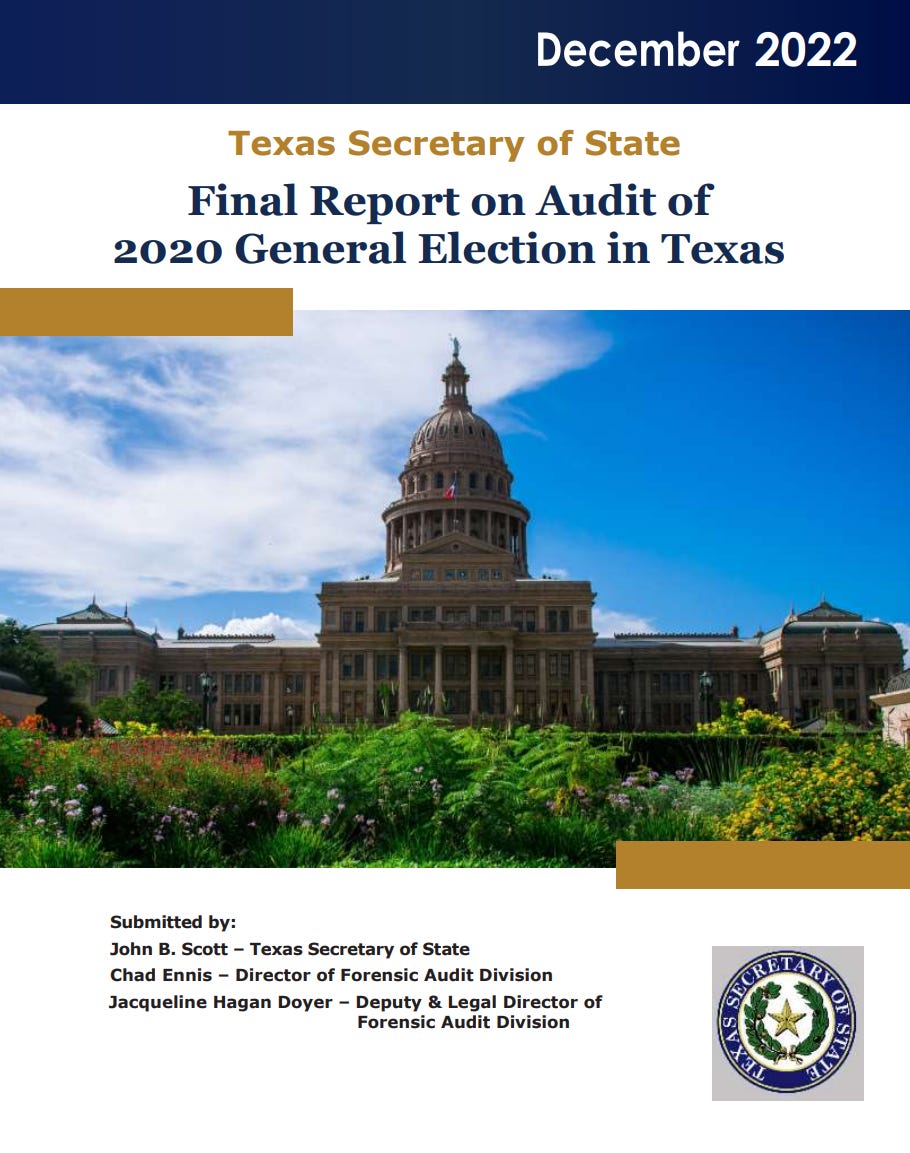
This audit showed a lot of wild things, including some things close to home. For instance, on Election Day 2020, at Thomas Haley Elementary School in Irving, there were 499 ballots cast but only 354 check ins (page 82). What the heck?
At least this was not as bad as an Oak Cliff polling location, where 233 people voted with only 156 check ins … but, even more concerning, none of those votes even got recorded. Why weren’t the ballots counted? The report leaves it an unexplained mystery (page 98-103).
So, votes can apparently just disappear, and even a state audit is unable to get to the bottom of it. Deleting a few voters here and there to get to a desired outcome could potentially pass unnoticed.
Unless you looked at the audit logs for the machines. The voting machines, tabulation machines, and pollbooks all generate detailed audit logs of all actions and events that have occurred on the unit, which show every action and event, including access attempts, access of system functions and errors, with their timestamps. The audit logs were not a part of our recount; but shouldn’t they be? When a candidate is spending thousands of dollars on a recount, it seems like there should be automatic access to things like the paper voter rosters, Ballot and Seal Certificates, and audit logs. Why wouldn’t there be?
In the state audit of the 2020 election in Dallas, though, the investigators did not look at the audit logs either, but just focused on election records and procedures, identifying discrepancies without reconstructing the system events with a forensic review.
The failure of the state audit was disappointing, but perhaps it was too big a task to do a full forensic audit of the four largest counties in Texas. The Secretary of State’s Office had their hands full just getting Harris County to fork over their records.
Not that Dallas did such a great job locating and turning over records either. The audit report has this to say about early voting at the Irving Arts Center:
The data for Irving Arts Center regarding check-ins contained significant discrepancies, largely due to the absence of records. For example, while the Daily Report Form and Handwritten Daily Voter Roster reflected approximately 11,500 voters checked in during Early Voting, the available pollbook tape records only showed 11,119 voters. FAD [the Forensic Audit Division of the Texas Secretary of State] is unable to account for the additional voters was due to tapes missing from the records. (Page 94)
Now for something really wild…
From the report:
In reviewing the records associated with Irving Arts Center, FAD observed a log that appeared on October 16, 2020 entitled the “Phantom Voter List.”
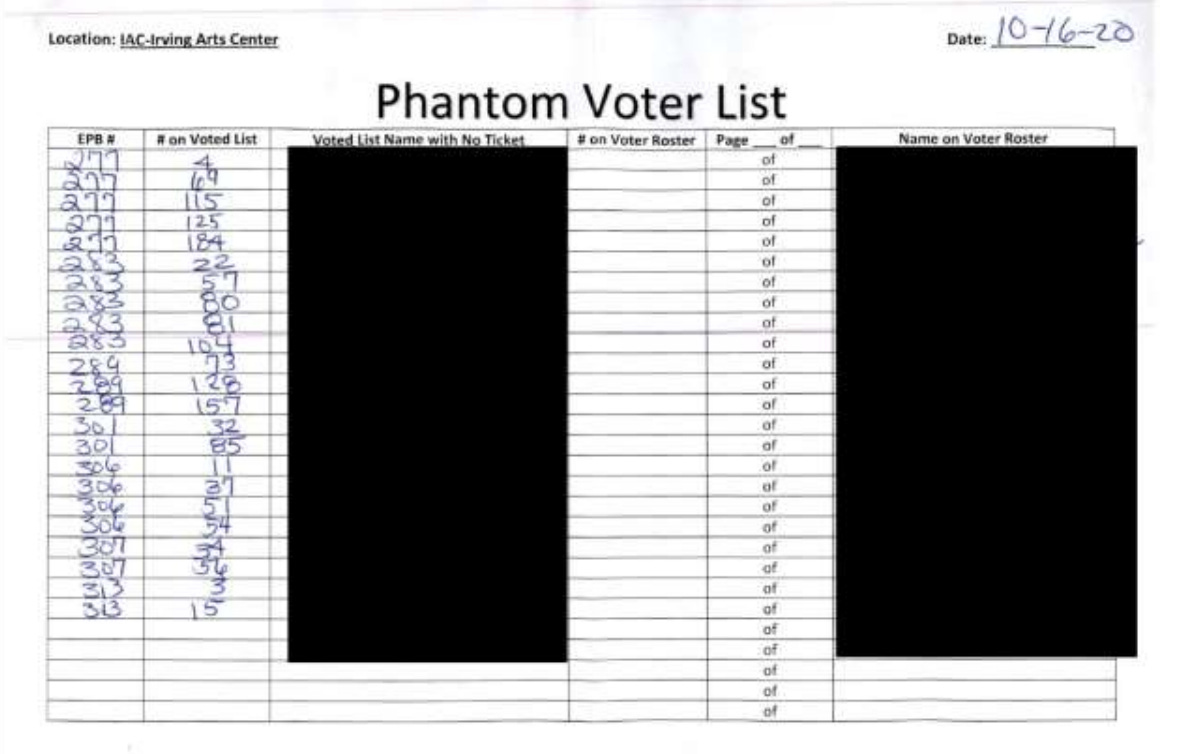
The list was tracking a strange phenomenon: voters were voting who did not show up to the polls.
The log reflects that there were names printed on the electronic pollbook tape that did not appear on the handwritten daily roster. An inspection of the tapes and handwritten rosters confirmed this was occurring. (Page 95)
Crazy! It was not just a glitch here or there, but so pervasive that someone created a form to track it. It was entitled: “Phantom Voter List.”
What in the world?? Who even created this form? Nobody seems to know:

Dallas County located some emails between members of their staff and ES&S [Election Systems & Software, which runs the pollbooks, voting machines, and tabulators] reporting the problem. Dallas County believed the problem had been fixed at some point but could not remember when or how. Dallas County also believed this form was used to keep track of what was occurring so that the proper voters were getting recorded as having vote history, instead of the “phantom voters” being printed on the tapes. FAD interviewed ES&S about the issue. ES&S understood the issue to be related to a non-unique identifier having been used when the list of registered voters was uploaded to the pollbook. ES&S also expressed they believed the problem had been resolved at some point, but was unsure how or when. FAD also interviewed VOTEC, Dallas County’s VEMACS voter registration system vendor. VOTEC explained that in preparing for an election, Dallas County uses the information from its voter registration system to export a list of registered voters for upload to the electronic pollbook. Periodically, the county will query the voter registration system to see if any changes or updates have been made that need to be made for the pollbook. VOTEC explained that after the export occurs, they have no insight into how the data is imported into the electronic pollbook. Voter records that are exported only contain two numerical unique identifiers: the driver’s license number and the voter’s VUID. VOTEC said they had heard of this occurring in other circumstances but were unsure of how or why. VOTEC said they reviewed their communications with Dallas County and there was no record of this issue that they were able to locate. (Pages 96-97, emphasis added.)
Goodness.
Nobody really knows anything apparently, and the Forensic Audit Division’s report just documented the problem without any attempt to get to the bottom of it:
The electronic pollbooks were producing unreliable records and for some days the handwritten rosters were missing entirely. It was not possible to fully reconcile the check-ins versus ballots cast at this location due to missing, incomplete, inconsistent, or unreliable records. (Page 97)
At least the issue got flagged so we know about it. But of course the reason it got flagged was because the pollbooks printed out tapes. Dallas County was praised in the report for this:
Dallas County’s practice of printing daily pollbook tapes – showing the names of voters – combined with their handwritten check-in log made the “phantom voter” issue easier to track. (Page 12)
But now, after switching pollbook vendors for this year’s election, we no longer have daily printed pollbook tapes. So what was used to flag “phantom voters” no longer exists. Problem solved!
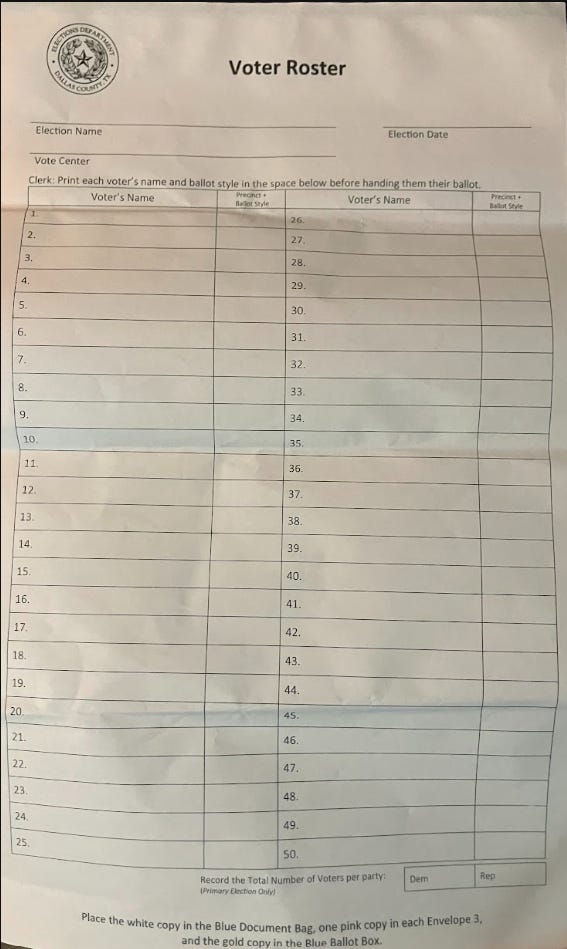
In the next post, we will talk about another critical piece of documentation that was not available for us to review during the recount, but that we managed to track down, examine, and which revealed further discrepancies: the paper voter rosters.
Stay tuned.
Contact: TheIrvingHerald@gmail.com (corrections/comments/news tips welcome)
© 2026 Irving Herald LLC. All rights reserved.