
We were able to participate in the recount last month of the City Council District 3 May 2 Municipal Election. Not something you do every day. It was illuminating, and we talked about the experience here.
In these detailed follow-up posts we’ll get in the weeds, in order to share some takeaways and analysis, and hopefully inform any candidates in the future considering or undertaking a recount.
This race was Abdul Khabeer, Kejal Patel, and Tammam Alwan, none of whom got an outright majority in the general election. We covered this thrilling race here.
The race went to a runoff between Khabeer and Patel, however ultimately only five votes separated Patel and Alwan, the latter calling for a recount.
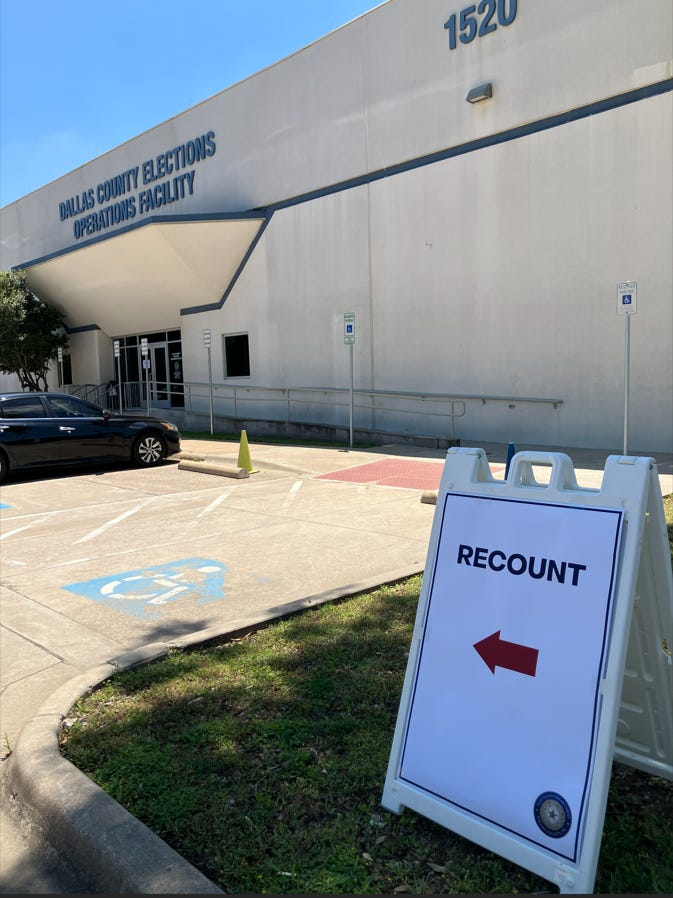
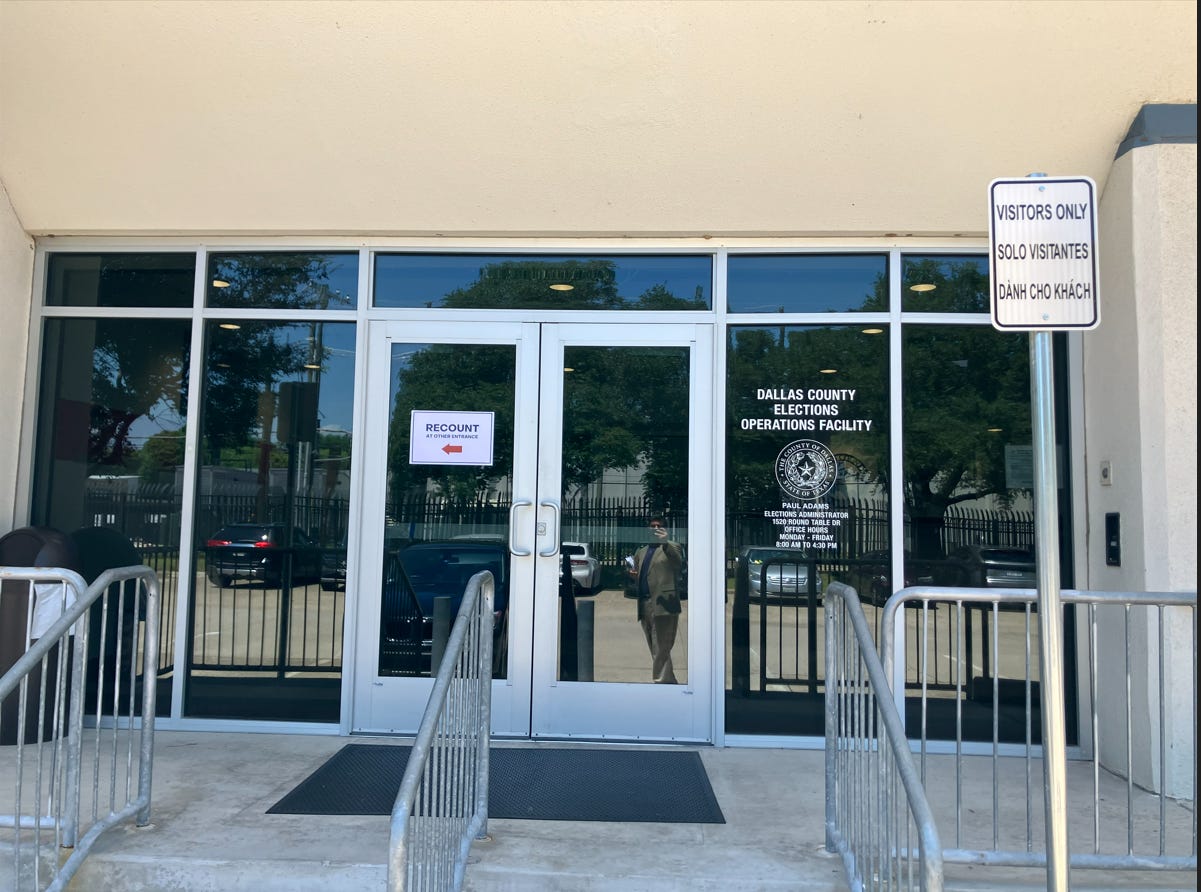
The recount occurred over two days — Tuesday, May 12 and Friday May 15, at Central Count — at the Dallas County Elections Department at 1520 Round Table Dr., in Dallas.
The procedures to request a recount are here, the Secretary of State’s Recount Guide is here, and the law governing recounts is here.
The first day was Early Voting and Mail In Ballots; the second day involved counting Election Day ballots and reconciling them.
Each ballot box is opened and the ballots sorted to find the particular race of interest. There is a computer printout — reports from the Central Accumulator, the main tabulation computer — that states the number of ballots cast for that race at that location. Once the counters get to that number, they stop, and that is why this process should not be called a “recount” but rather a “retabulation.”
To see what the process looked like, here’s video of the livestream:
An erstwhile District 6 City Council candidate has a cameo
serving as a watcher for the Kejal Patel campaign
You’ll see the watchers observing the counters. For candidates doing future recounts, the best practice for watchers is to record results with tally marks as they are called out in a table with candidates forming the columns and ballot styles the rows.
The video stream has no sound, does not really show what is happening, and is not archived online. Cell phones are not allowed in the room. It is unclear why that should be the rule except to make it difficult to document what occurred.
Importantly, we were not given the Ballot and Seal Certificates for each ballot box. We asked for one and it was provided, however, all of them should have been available and ready as each ballot box was examined. That way, we could cross-check the seal numbers on the boxes as they were being broken into with what the seal numbers said on the form. When asked, the Deputy Elections Administrator Malissa Kouba said they weren’t done being processed yet; she did not explain exactly what processing still hadn’t happened ten days after the election.
Here is the one we asked for and received, for the BAPS voting location:
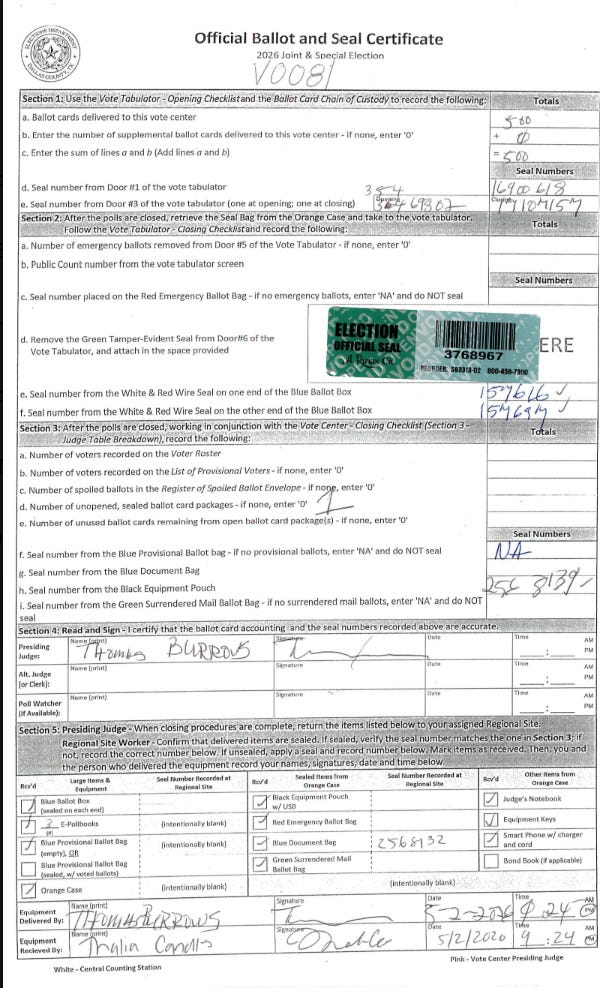
You can see there are problems with the way the judge filled it out. Sections are blank that should be “0” or “N/A” (sections 2a, 2c, 3b, 3c, 3e). More importantly: (a) the signature of the presiding judge omitted the date and time, (b) the clerk did not sign it at all, (c) section 3a, “Number of voters recorded on the Voter Roster” was left blank, and (d) section 2b, “Public Count number from the tabulator screen” was also blank.
Those last two are key numbers, showing the number of ballots counted by the tabulator at closing, and the number of voters as recorded in the paper voter roster.
Why was this form accepted by Elections Department staff when it was dropped off?
Not only did they accept it, they failed to record the seal number for the ballot box. So in our recount, even after requesting and getting this form, it was not possible to verify that the seal on the ballot box was indeed the seal that was put on the box by the election judge. Likewise, there was no seal number for the pouch that contains the USB drive.
This is unnerving. In this circumstance, anyone with an admin password and access to an ePollbook and tabulator at central count could vote as many ballots as they wanted, add them to the ballot box, and this fraud would be untraceable in any recount.
Also, if the vote totals are not recorded, there’s no way to follow state law that mandates retabulating ballots in case of discrepancies.
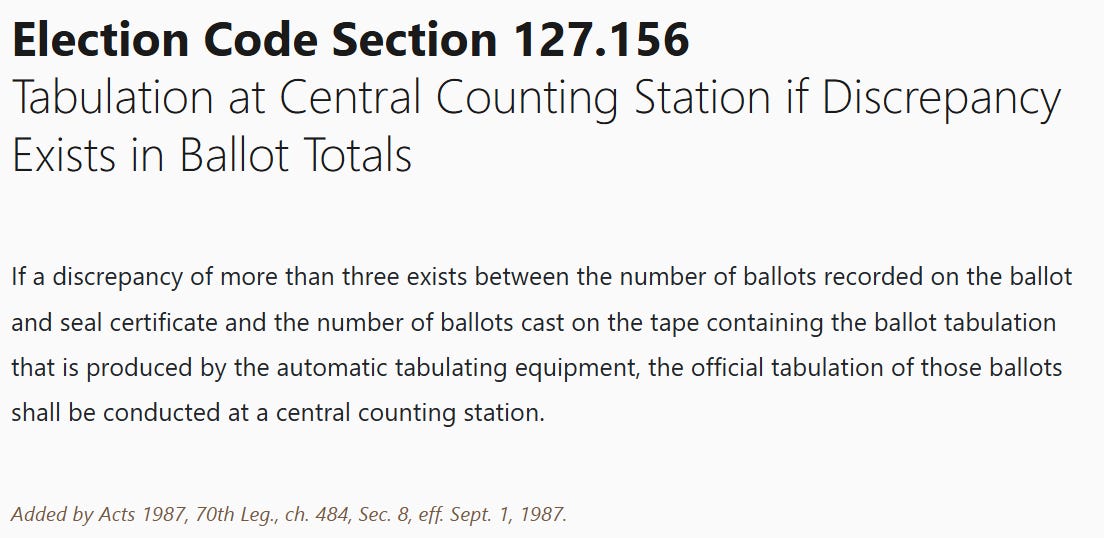
As we heard on our podcast on this topic, the response the candidate requesting the recount gave when he was told of this law was, “How is it OK to have a three vote discrepancy, when making the runoff was decided by only five votes!?”
He has a point. There were 34 voting locations on Election Day. If each of them is off by 3, that is a total of 112 votes, and in low-turnout municipal district election, that can be a massive number. Anyone with access to the system could delete the votes of three voters for a candidate in each location, controlling any tight race in a way unable to be traced, since a recount — really just a retabulation of the computer’s result, in the absence of access to see the Ballot and Seal Certificates, the paper Voter Rosters, and the audit logs — would not be capable of revealing any discrepancy. Recall that the “recount” just relies upon what the computer says; as soon as the counters get the result the computer printout says is true, they stop. If there is no ability to cross-check the computer numbers, there would be no way to detect this type of fraud.
Contact: TheIrvingHerald@gmail.com (corrections/comments/news tips welcome)
© 2026 Irving Herald LLC. All rights reserved.
Thank you for taking off work and participating in this recount or retabulation process. I hope that election judges can learn from this to fill out forms completely, the Dallas county election department can require filled out forms and that the state can learn from the recount to tighten security.