
This is the third in a series of posts offering reflections on our elections as a result of participating in a recount of the recent City Council District 3 May 2 Municipal Election.
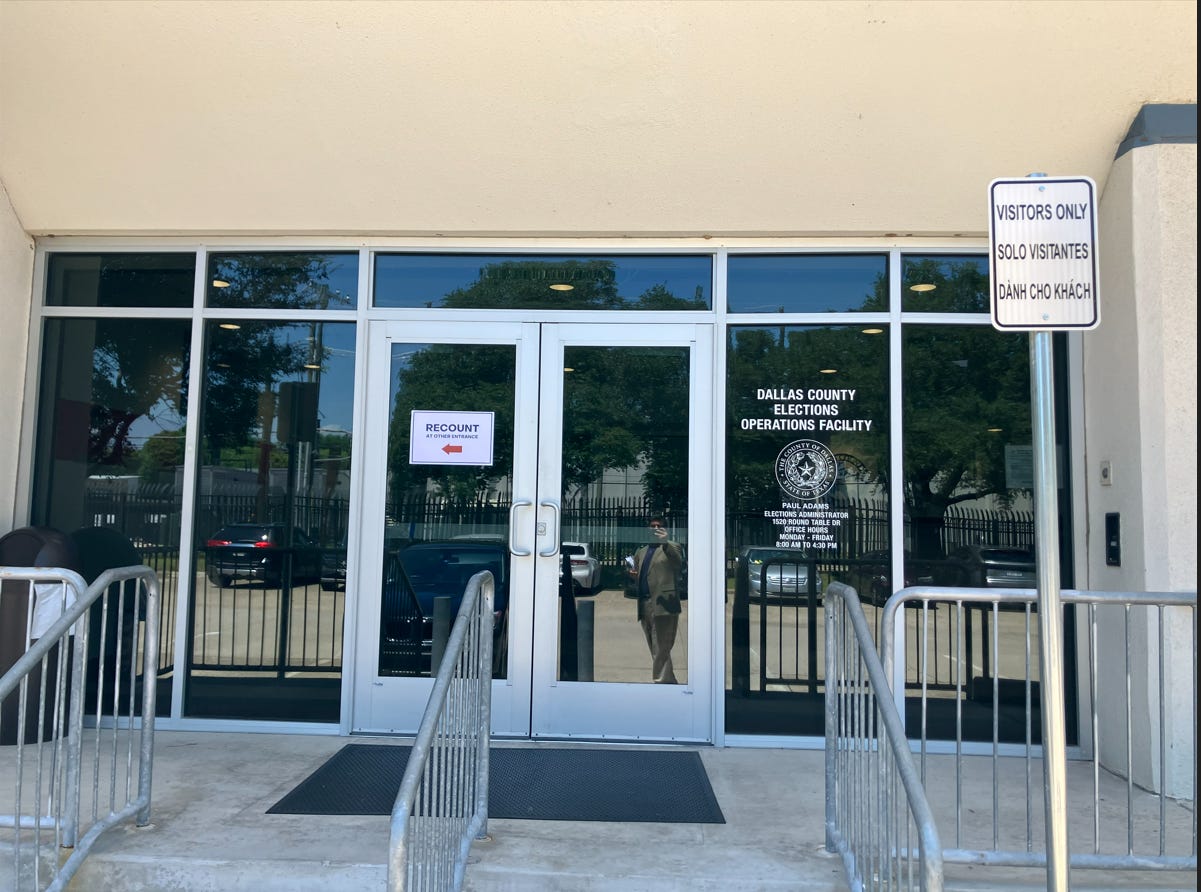
In the first post, we discovered a serious flaw in the recount procedure — the lack of access to a piece of absolutely critical documentation, the Ballot and Seal Certificates. Without access to these, neither the seals on the ballot boxes nor the total number of ballots can be verified, making fraud untraceable in a “recount” (making it a mere retabulation).
In a follow-up post, we found that concerns about election security are far from academic speculation. This was revealed by a statewide audit of the 2020 elections. That uncovered entire locations whose ballots were not counted, as well as the wild phenomenon of “Phantom Voters” in Irving: voters who “voted” without ever showing up (!) Unfortunately, while the “audit” by the state, which did not deserve that name, discovered this crazy factoid, it failed to get to the bottom of it. It left it documented but unexplained.
At least it was discovered, though, because the e-pollbooks printed out tapes of voters, and as a result the election workers thereby caught the “phantom voters.” Of course, for this past election cycle, Dallas County switched e-pollbook venders who provided pollbooks which do not print out voter tapes at all, so now something like “phantom voters” cannot be caught.
Not comforting!
In this post, we look at another aspect of Dallas County elections that could be greatly improved with a simple change, as we shall see and that, yet again is a critical piece of documentation that was not a part of the recount: the paper voter rosters.
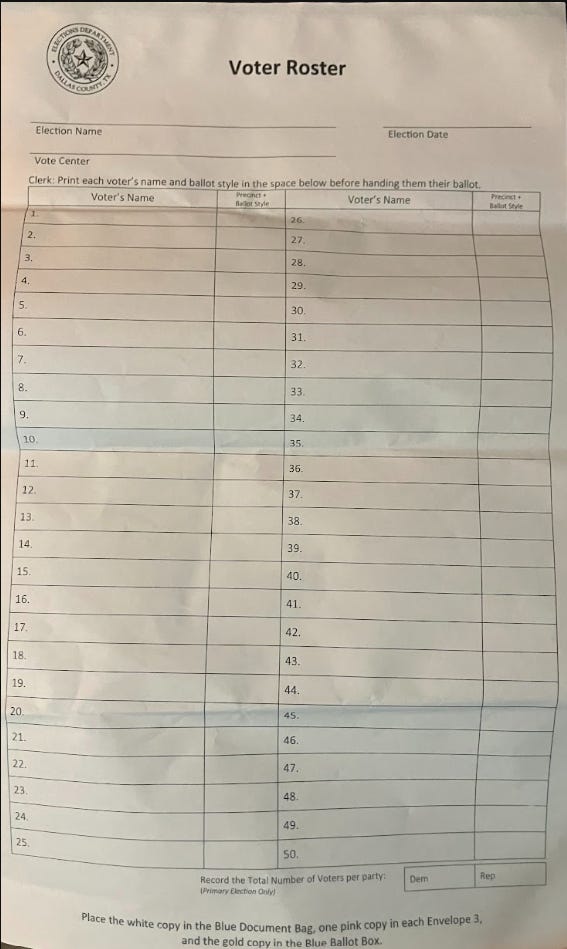
The paper voter rosters are the sign-in sheet that the election clerks make of voters who come to check in to vote. Except, as we shall see, the voters do not actually sign in.
Voter rosters are in triplicate. The election judge puts one in the ballot box, one in the document bag that is turned in to Elections Department staff, and one, pink copy that goes home with the election judge, the paid volunteer who is in charge of a voting location. That pink copy must be held by the judge for 22 months.
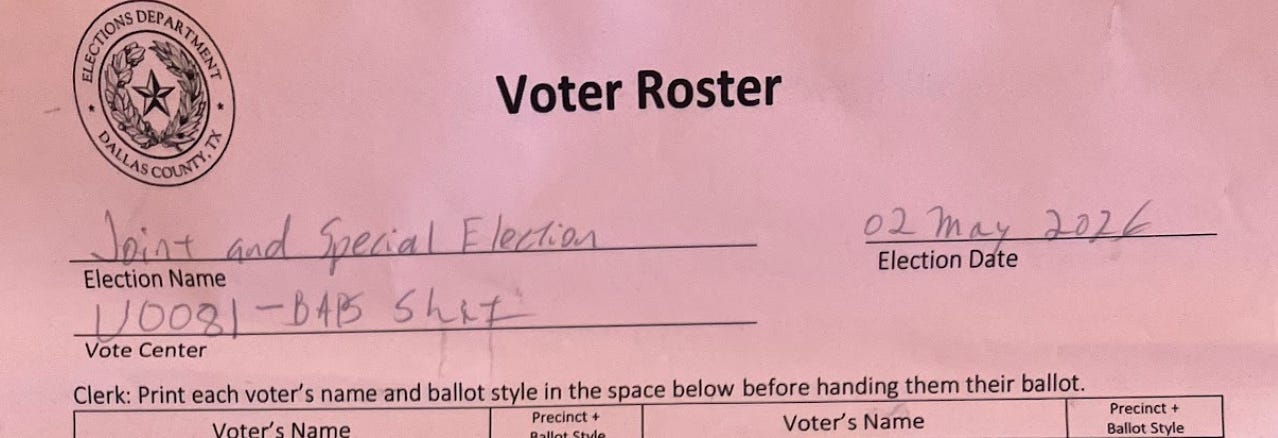
For the critical BAPS location (where the late night vote drop happened in this race), we were able to example the pink copies.
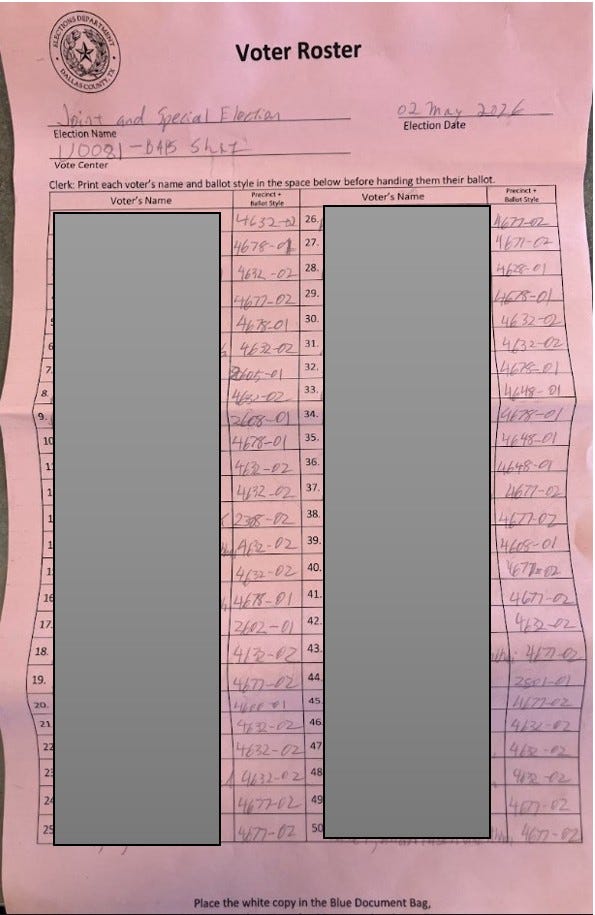
Why did we have to track down the election judge for this though? The voter rosters were in the ballot boxes, after all. We saw them there. However, during the recount when we asked if we could look at one, the recount manager said, “No, that’s not part of the recount” and did not let us look at it.
But the paper voter rosters absolutely should be part of recounts. As we opened up the ballot boxes for each location, we were given a computer printout of the number of ballots for the District 3 race. That printout was treated as gospel truth. The counters would go through the box until they found that number of ballots … and then they would stop. But what if the computer print out was wrong, and there were more ballots in the box? The recount would never show it.
As a result, we were just retabulating votes. It was not a real recount.
The computer printout can treated as gospel truth only when access is denied to the records that would flag discrepancies.
In this case there were discrepancies. To wit: the number of voters in section 3a on the Ballot and Seal Certificate should have shown 162 voters, not 160.
What happened? Our detailed examination of the paper voter rosters for BAPS showed two voters with very similar names showed up a little after 1:00pm on election day according the paper voter roster, but only one of them was recorded as voting. The same thing happened again at a quarter to 4:00pm. In both of these cases, perhaps we were dealing with two people who were related, and one of the ballots was not recorded (which would be a problem), or perhaps it was just one person with a name that got entered twice — an error. Errors by election workers happen, which is why state law requires a retabulation only when there is discrepancy of 4.
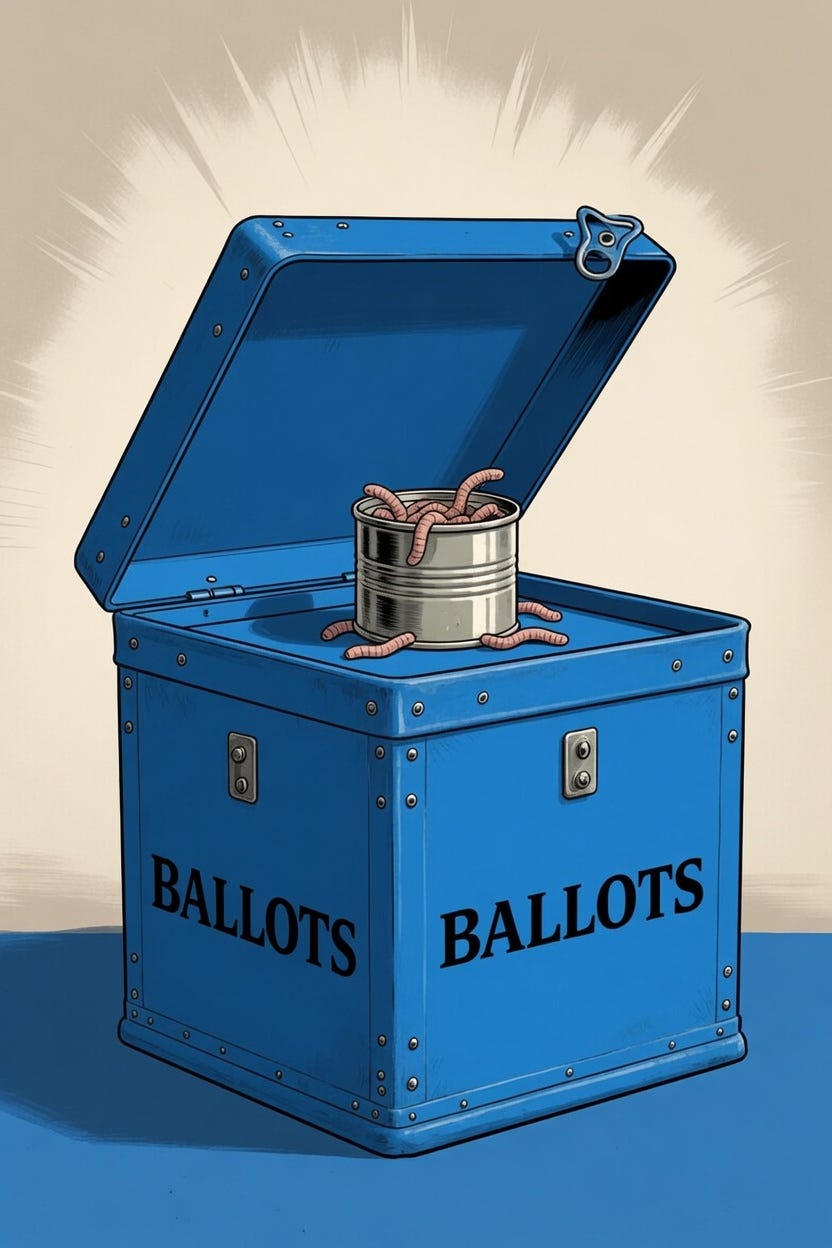
There would surely be other discrepancies on other paper voter rosters as well. Without access to them, though, everything seems copesetic. Without a doubt, the elections department knows they are opening a can of worms if they let voter rosters be looked at in recounts. Their incentive is to get the recount over with as soon as possible with as few questions raised as possible. It’s the incentive of bureaucracies everywhere.
The recount process therefore revealed that the Dallas County Elections Department wants our elections to seem secure, without taking the obvious steps to actually make them secure. We spend tens of millions of dollars on elections in Dallas County a year … yet we do not take simple steps to actually secure our elections.
Here’s a simple change that could be made: rather than the election clerks writing down the name of the voter on the roster, (a) have the voter sign the roster, (b) put a line at the bottom for the clerk to sign and date, taking responsibility for it, and (c) make them available in recounts for inspection.
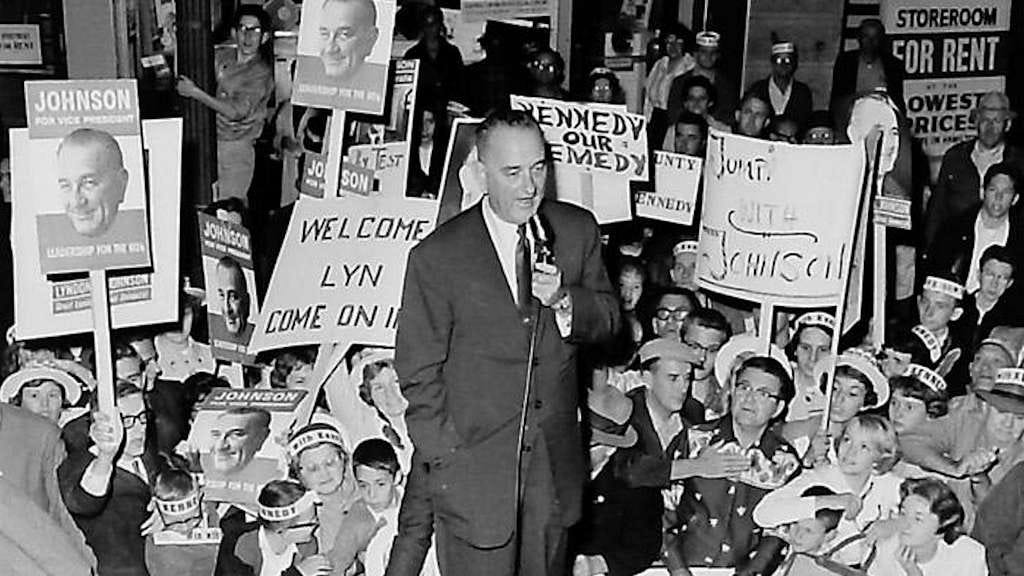
That would show fraud simply and easily. A candidate could see in a recount whenever voter signatures are in the same handwriting. As a matter of fact, that’s how Coke Stevenson’s team discovered that the ballots that put Lyndon Johnson over the top in the 1948 US Senatorial election in Texas were fraudulent. His team found the voter list where the final 200 names were names in alphabetical order, written in the same handwriting and same ink. They then went and asked those people if they had voted, and they said “no.”
We might even call them “Phantom Voters.”
Tens of millions of dollars to run our county elections and we cannot do the simplest thing that proved fraud last century.
Again, all the money and procedures seem designed to produce the illusion of secure elections, rather than taking the obvious steps necessary to actually secure them against fraud. Election workers must complete tons of steps and complicated forms to pull off an election; it’s no surprise election workers get confused. But can we not ask the voter to simply sign the paper voter roster? Also, the election clerk should have responsibility for this documentation, and sign the bottom of the form. All this would cost $0, take up zero additional time, and yet be a big boon to actual election security.
Such a change would also provide safeguards when it comes to signature verification. Currently signature verification is a joke. It is not even covered in the training of election workers. One would expect election worker training to include something along these lines: “After the voter signs, check the signature. If the signature does not match the ID, notify the judge, and here’s what you do…” But there was nothing of the sort. All signatures are to be considered valid, apparently.
Also, signatures on a screen are different from paper. People sign paper in their natural, habitual way, and there are forensic protocols to verify it. On a screen? We sign differently. A “signature” is just a ridiculous scribble.
If voters signed the paper voter roster, and that was available in the recount, signatures that looked the same should be able to be compared to their signatures on file. In this case there would be at least the threat of a more robust signature verification. This would be a deterrent for fraud.
The infuriating thing is this change would cost $0 and zero time. There is literally no reason not to do it, unless you do not want elections to be secure. We spend millions to make elections complicated and seem secure, when we could actually make them more secure with simple changes.
We need to demand those changes.
Contact: TheIrvingHerald@gmail.com (corrections/comments/news tips welcome)
© 2026 Irving Herald LLC. All rights reserved.